
When it comes to deciding on which Koi to buy there are several things to be taken into account. Obviously there is not simply the cost to consider, you want to be sure that you are getting good value for money too.
So what is it that determines the price of a Koi?
Well, for one thing there is the cost of getting it to the UK. They have to come the quickest way – so that is by air freight and contributes quite a proportion of the cost.
After that it is a matter of what price the breeder puts on the fish, and that depends on a number of factors including:
Bloodline
The earliest mention of what we now know as Kohaku goes back to the early 19th century which describes a natural colour mutation. The fish had red colouration on the cheeks, making it stand out from other wild carp.
The descendants of this carp included completely red and white fish which were interbred over several generations, eventually resulting in a white koi with a red pattern.
Over the next 60 or so years several breeders worked to refine and stabilise the genetics and eventually the kohaku came into being early in the 20th century, to be followed over the next hundred years by the huge range of varieties we know today.
Today there are a number of breeders whose fish can be traced back to these early bloodlines, and several have become famous as their fish have regularly won accolades in the biggest and most prestigious Koi Shows in Japan.
Knowledge of the bloodline of a koi is a critical factor when it comes to making judgements on the likely growth and development of a koi, both from the point of view of body shape and eventual pattern. Some of the more well-known and sought-after bloodlines include:

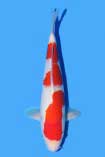
- Tomoin
- Sensuke
- Matsunosuke
- Dianichi
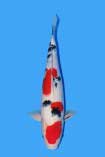
- Torazo
- Jinbei
- Sadazo
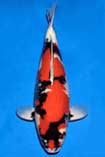
- Dianichi
- Kobayashi
- Suda
Kawarimono
Many breeders are now producing a wide range of Kawarimono varieties in addition to Go-sanke.
Koi Farms famous for their Kawarimono varieties include:
- Aoki – for scaleless metallics, Yamatonishiki, Kikukuryu, Beni Kumonryu
- Hiroki – Shiro Utsuri, Asagi, Doitsu Kojaku
- Hiroi – Goshiki, Gin Rin Showa, Ogon
- Ikarashi – for Yamabuki, Goshiki, Kin Ki Utsuri.
- Marusei – Ogon, Hi-utsuri, Go-sanke
- Ohya/Hoshino – Shiro Utsuri. Sanke
- Omosako – Shiro Utsuri, Showa
- Ooya – Yamatonishiki, Kumonryu
- Otsuka – for Asagi, Goshiki
- Oyaji – for Gin Matsuba, Hariwake, Shusui
- Sakazume – Ai-Goromo, Budo-Goromo, Yamatonishiki, Showa
- Yamacho – Platinum Ogon, Matsuba, Kikukoryu
- Yagenji – Go-sanke, Shiro Utsuri, Kikusui
- Yamasaki – Hariwake, Koromo, Shusui, Ochiba
Skin Quality
The quality of the skin, the intensity of the colour and pigmentation of the skin are paramount.
The Shiroji should be pure and snow-like, the sumi rich and soot-like, and hi should be solid and well defined, though, in Kohaku for instance, colour can range from deep orange to deep red.
Koi normally display their best colours a few days after they are harvested from the natural ponds in which they are grown. A few days in clear cool water and they can become amazing.
In the UK colours are enhanced by cold conditions and appropriate feeding.
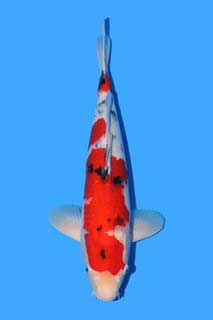
The Pattern and colour distribution
The pattern should generally be evenly distributed, providing a balance over the body of the fish. This applies to both sides as well as from head to tail.
However, it has been said that a fish that is 100% balanced can be boring. A small deviation from symmetry therefore can be more interesting.
Generally speaking, multi-coloured koi should be white at the snout and at the caudal peduncle (where the tail meats the body). This makes them stand out better in a dark pond.

Body Form
This can be an indication of the age of the fish, and it’s potential eventual size.
Champion Koi are almost always “jumbo”, ie. greater than 85 cm in length, and small fish rarely achieve the very top prizes in competition.
The body should give the impression of power and muscularity and the mouth should be broad.
The body form of a fully-grown koi should be impressive, and the fish will normally glide through the water with little apparent effort, whereas half-grown fish swim more rapidly and use a lot more energy.
Growing fish should normally look spindle-shaped and elongated.
Each variety has its own ideal body form. (see appropriate section of the Koi Variety Guide)


Age
Much like humans Koi develop over time. As they grow, the skin thickens and becomes more opaque, the body shape changes and their patterns develop.
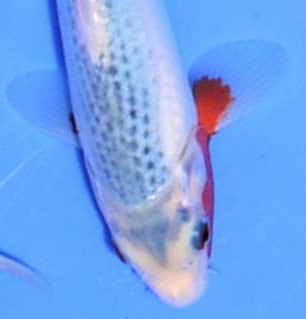
In very young fish the skull and skin covering it can be very thin. This makes the fish appear to have a grey rectangle on its head and the overall impression of the head can look “dirty”.
This reduces as the fish grows and the skull and overlying skin thickens.
Tategoi and tateshita are koi considered – by their breeders – to have the greatest potential and worthwhile growing on. However, it can never be guaranteed that they will develop as expected.
AND, don’t forget – fully mature koi can be over a metre in length, and can be 10 years old or older depending on their bloodline. Only then can a koi be considered “finished”.

Online Shop
Discover our stunning selection of koi! We’re constantly updating our online shop with new arrivals. Browse our extensive collection and find your perfect pond centerpiece.
So – there are lots of things to think about.
Koi, like Koi Keepers, come in all shapes and sizes.
The Koi you decide on should be what pleases you, whether it is large expensive “finished” koi, or smaller less expensive ones that you can have the pleasure of watching grow up. As they say –
“You pays your money
and
you takes your choice”.
and don’t forget – they have all been bred from wild, plain brown ancestors.
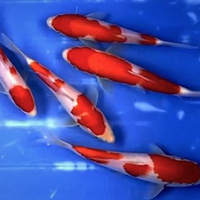
Some of the best fully quarantined Japanese Koi available in the UK
Our koi go through a four-week CEFAS approved quarantine programme and PCR testing on arrival in the UK
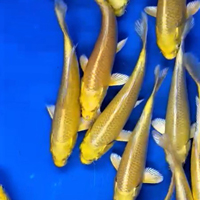
We personally select all our Koi
There are many breeders to choose from. We have dedicated a page to highlight some of the ones that our Koi come from.

Contact us and arrange a visit
We are based in Sawbridgeworth, CM21
Please call us on:
Geff: 07940 456004
Jan: 07702 266712
or email us at koiman.enterprises@gmail.com
to arrange a visit