
There are however, a huge range of varieties to choose from, and each has its own set of “varietal standards”.
This brief guide to Koi Varieties is intended as an aid to learning about, and appreciating the many koi variants.
It can be difficult for even the experts to keep up with all the modern trends. The short descriptions here will help identify your favourites.

Kohaku
Kohaku, the oldest and most well-known variety of koi, have a solid white base with red patterns overlaid on top of the white.
Top quality Kohaku display a bright, blemish-free white skin combined with deep, vibrant and uniform red tones to the pattern.
The shade of red is dependent on the blood-line, and varies from orange red through to a blue-violet tone. Intense bright sunlight is required if the fish is to achieve its optimal colouration.
The scales of white areas should have a silky look.
Kohaku can be further subdivided by an additional term which describes the distribution of the pattern.
The even distribution of the pattern along the body is also very important, as is the sharpness of kiwa – ie the posterior borders of the pattern.
The body form of young fish should be elongated. They should be generally spindle-shaped and streamlined, until almost fully grown, at which point they begin to fill out with the widest part slightly in front of the dorsal fin.
The head should be round and “chunky”.
Bloodlines include: (which display these characteristics) Dianichi, Hoshikin, Manzo and Sakai (see Koi Strains).
Variations of Kohaku include: Doitsu Kohaku, Gin Rin Kohaku, Maruten Kohaku and Tancho Kohaku. Metallic varieties (Gin) are not considered true go-sanke, and sit within the Kawarimono group of Koi Varieties.

Tancho
Tancho are highly regarded in the Japanese koi industry for their resemblance to the Grus japonensis, or Red-Crowned Crane, and of course, the Japanese flag.
It is a hugely popular variation of Kohaku, in which the red pattern appears only as a single red dot on the head.
Skin quality and body form should comply to kohaku guidelines. The symmetry and placement of the Tancho mark are main factors in determining the quality of any particular koi.
Although the Tancho marking can appear in many varieties of koi, the word “Tancho” by itself is almost always used to refer to Tancho Kohaku.
Variations of Tancho include: Gin Rin Tancho and Doitsu Tancho. Metallic varieties (Gin) are not considered true go-sanke, and sit within the Kawarimono group of Koi Varieties.
Taisho Sanke
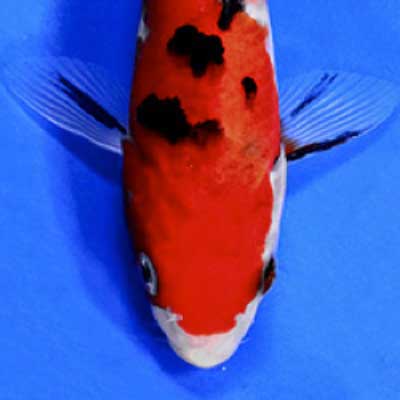
Taisho Sanke, or Sanke for short, are koi with a solid white base overlaid by patterns of both red and black.
It is commonly said that Sanke of high-quality need to first display a great Kohaku pattern, on which the black (Sumi) is overlaid and well distributed. The Sumi is often subdued in young fish, and normally develops as the fish grows.
The body form of young fish should be elongated in form, this shape retained until almost fully grown at which point they begin to fill out. They should be generally spindle-shaped and streamlined, similar to that of the Kohaku.
The head should be more triangular in the snout region than that of the kohaku.
Bloodlines include: Torazo, Kichinai, Jinbei, Sadazo, Dianichi & Matzunosuke.
Variations of Sanke include: Doitsu Sanke, Maruten Sanke, Tancho Sanke, and Gin Rin Sanke. Metallic varieties (Gin) are not considered true go-sanke, and sit within the Kawari group of Koi Varieties.

Showa Sanshoku
Showa Sanshoku, more commonly known as Showa, are koi that display white and red/orange patterns overlaid on top of a black base colour.
Showa can be easily confused with Sanke. In Showa, the black patterns will wrap all the way around the body, instead of appearing only on the top half of the body. Also, Showa will have black patterns on the head, which Sanke rarely do.
The red, white and black should be balanced about the body evenly, with crisp, clean edges between each colour.
The body form should be sturdy and lozenge-shaped, with the widest part of the body should lie just behind the shoulder.
Bloodlines include: (which display these ideal characteristics) Kobayashi, Dianichi, Shinoda and Ueno Koi Farms (See Koi Strains).
Variations of Showa include: Tancho Showa, Maruten Showa, Gin Rin Showa, Doitsu Showa and Kin Showa. As with Sanke, metallic varieties (Gin) are not considered true go-sanke, and sit within the Kawarimono group of Koi Varieties.

Shiro Utsuri
Utsurimono are koi with a black body overlaid with a coloured pattern.
Shiro (white) Utsuri are koi with a black base overlaid by areas of white.
A high quality Shiro Utsuri will combine clean white patterns with a deep, lacquer-like black. The patterning should be an interesting design, evenly distributed across the entire body., though it is rare for the sumi to be completely homogeneous. A split head of both black and white is also an important requirement for top quality specimen. The colouration of the pectoral fins is often an indication of the subsequent sumi development and distribution.
Truly top-quality sumi is only achieved when the Koi reaches adulthood, and therefore the sumi on young fish should not be taken as an indicator of it’s eventual patternation.
Their growth and body form characteristics follow that of the Showa.
Bloodlines include: Kobayashi, Seki, Omosako.
Variations of Shiro Utsuri include: Gin Rin Shiro Utsuri, Gin Shiro Utsuri and Doitsu Shiro Utsuri.
Hi Utsuri
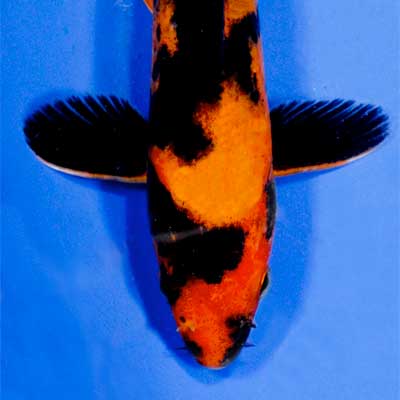
Hi Utsuri – Red Hi Utsuri are superior to orange.
Many Hi Utsuri will display a dull orange pattern at a young age, which may develop into a brighter and more desirable red pattern as the koi grows and matures.
Their growth and body form characteristics follow that of the Showa.
Bloodlines include: Shinoda.
Variations of Hi Utsuri include: Gin Rin Hi Utsuri and Doitsu Hi Utsuri.
Ki Utsuri
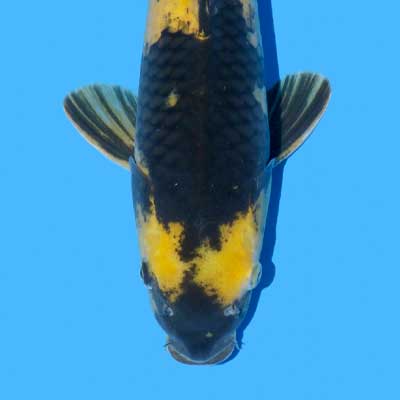
Ki-Utsuri- a yellow Utsurimono, and the oldest variety in the group.
Ki Utsuri are by far the rarest type of Utsuri, combine patterns of yellow over a lacquerish black body.
Ki Utsuri are judged by the same criteria as Shiro and Hi Utsuri.
Bloodlines include: Shinoda, Hirasawa.
Variations of Ki Utsuri include: Gin Rin Ki Utsuri and Kin Ki Utsuri.
Asagi
Asagi is one of the oldest koi varieties. The original ancestors of the modern strains came from the Gunjo Stain, which also led eventually to the development of Matsuba and Kigoi. The Narumi Asagi, which has white scale pockets and lighter edges to it’s scales, is regarded as an ancestor of all white skinned koi varieties, including Kohaku, Sanke, Bekko and Goshiki.
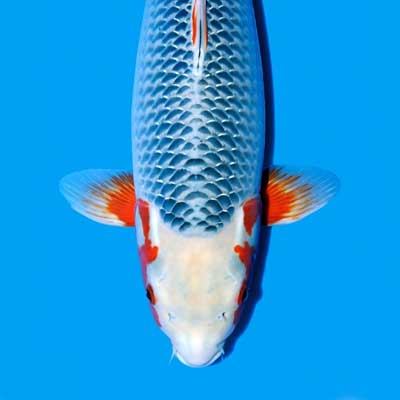
On their backs, these koi that display a blue net-like (reticulated) pattern on a dark blue background, complemented by red or orange on the belly, gill plates, fins and body. They should have a white top to the head.
The red or orange pattern will normally develop up from the bottom of the body as the koi ages. In young asagi the pattern is only starting to develop. Top quality Asagi have a red pattern that does not extend above the lateral line.
The Asagi body form is usually slender and pointed.
Bloodlines include: Otsaka, Hosokai, Igarashi.
Variations of Asagi include: Gin Rin Asagi and Hi Asagi, as well as the recent Gyakume variety developed by the Otsuka koi Farm.

Shusui
Shusui are the scaleless (doitsu) version of Asagi, and its development paved the way for all subsequent Doitsu varieties.
The blue net pattern is replaced by a single row of scales along the dorsal line at the top of the back. Like Asagi, the belly, gill plates, sides and fins of Shusui display an orange or red pattern.
The body form is similar to that of the Asagi.
Bloodlines include: Jamajo, Oofuchi and Tomaso.
Variations of Shusui include: Gin Rin Shusui, Hanna Shusui (where the red pattern appears as separate round spots), Hi Shusui, as well as the Kousui which is completely unscaled.

Matsuba
Matsuba are a development of the Ogon variety, and are koi which combine a solid, metallic coloured base with a black reticulated, net-like pattern (often described as pine-cone effect).
This effect is created by each individual scale having a black edge. The dark half moon on each scale should be clearly defines creating a strong contrast with the base colour.
As with Asagi, gaps and unevenness in the scalation is undesirable.
The base colour of Matsuba can vary. Gin Matsuba have a white base colour, while Ki Matsuba have a yellow base colour, and Aka Matsuba have a red base.
Body form follows the standards of the Ogon.
The sole variation of Matsuba is Doitsu Matsuba.

Platinum Ogon
A Platinum Ogon, also known as Purachina, are solid, metallic-white koi.
A clear white head and unblemished white body are crucial to the quality of a Platinum Ogon, which can be traced back to the Marusei Koi Farm.
Bloodlines include: Hirasawa, Chogoro.
Variations of Platinum Ogon include: Gin Rin Platinum Ogon and Doitsu Platinum Ogon.
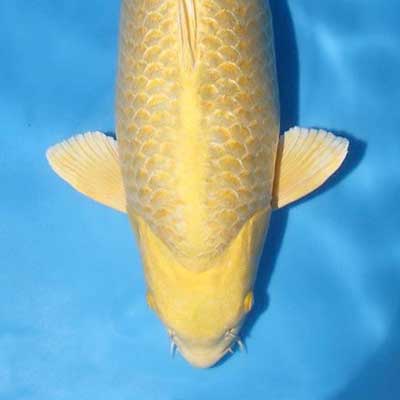
Yamabuki Ogon
The term Ogon signifies a monochrome koi with a metallic sheen, and this is prefixed by the term indicating colour.
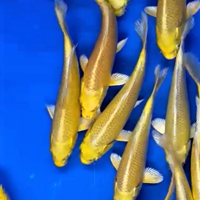
Yamabuki Ogon are koi of a solid, metallic-yellow colour. It’s origins date back to the 1940’s when Sawata Aoki presented the Yamabuki for the first time. Thanks to it’s rapid rate of growth Yamabuki became the basis for w number of new varieties in the Kaawarimono group.
As with other Ogon koi, a clean, unblemished head and body are important, as is the 3-D appearance of the scales. Quality does not depend on the exact shade of yellow, simply that the colour is consistent and unblemished. The scale pockets are always a lighter shade than the scales.
The body form should be long in length and round in cross section, and should be symmetrical, with a round head and large rounded pectoral fins.
Bloodlines include: Shinoda, Hirasawa, Marusei Koi Farm.
Variations of Yamabuki Ogon include: Gin Rin Yamabuki Ogon and Doitsu Yamabuki Ogon.
Orange Ogon are termed Orenji. Kuro, developed from the original Magoi, has a metallic background with overlying black.

Mizuho Ogon
The term used for doitsu Kin Ogon.

Kujaku
Kujaku, the Japanese word for “peacock”, are koi with a solid white base, with patterns of red/orange/yellow, with the addition of the black net-like, reticulated pattern of the matsuba. The net pattern is created by a black edging on each individual scale.
The orange-red pattern, depending on the strain, can vary from light yellow to deep metallic red. The ideal pattern distribution should follow that of the Kohaku. Fins should ideally be white through to the tips, though an orange colouration on the pectoral fins (akamoto) is not considered to de-value a Kojaku, so long as it is clearly defined and symmetrical.
Missing scales or uneven patterning are considered a fault.
Bloodlines include: Hirasawa.
Variations of Kujaku include: Doitsu Kujaku, Tancho Kujaku and Maruten Kujaku.

Hariwake
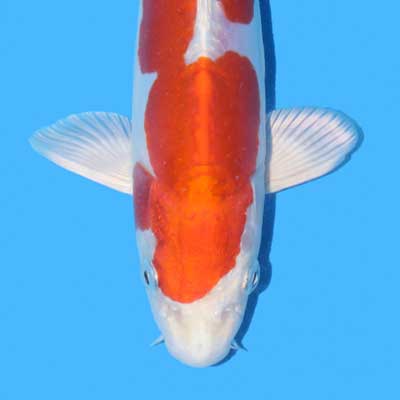
Hariwake, sit within the Hikarimoyomono group, and display a solid metallic, platinum-white base coupled with bright, vibrant patterns of yellow or orange (sometimes called Sakura Ogon).
The pattern distribution should be similar to the Kohaku, and the fins should be pure white right to their tips.
The bright, luminous white of Hariwake differs from the softer, matte-white of Kohaku and Sanke. Hariwake with a bright yellow pattern are commonly referred to as Lemon Hariwake.
Variations of Hariwake include: Tancho Hariwake, Gin Rin Hariwake, and Doitsu Hariwake (also known as Kikusui).
Kikusui

Kumonryu
Kumonryu are scaleless (doitsu) koi with patterns of grey or white combined with black. The name translates as “dragon”.
The term doitsu as a prefix is unnecessary as all Kumonryu are unscaled.
Probably the most intriguing variety of koi, Kumonryu will completely change their pattern many times throughout their life. It is only after the third year that the pattern begins to stabilise.
There should be a precise boundary between the black and white pattern which can range from solid white to solid black, or any conceivable combination in between. The head and fin edges should be clear snow-white, contrasting with and complimenting the rest of the black & white patter.
Many doitsu varieties are being crossed into Kumonryu strains in order to improve the intensity of the white background. They have resulted in a large number of variations between the true Kumonryu, with it’s silky white background and the metallic Kikokuryu. Not only the white, characteristics are inherited. Inheritance of the red pigmentation has led to the development of the Beni Kumonryu and Beni Kikukuryu varieties. (See below)

Beni Kumonryu
Beni Kumonryu are Kumonryu with the presence of a third colour, red.
Just like Kumonryu, Beni Kumonryu can change their pattern completely many times throughout their lifespan. Ki Utsuri are judged by the same criteria as Shiro and Hi Utsuri.
Bloodlines: mainly derive from the Aoki Koi Farm.

Chagoi
Chagoi are solid coloured brown or bronze (often described as tea coloured)koi with a subtle reticulated net-like pattern, and derive from the early Ogon lineage.
Although they are not nearly as flashy or colourful as other types of koi, Chagoi are still a welcome addition to koi ponds.
The frequent in-crossing of these Koi has created a “loose” set of blood-lines which has led to them possessing many characteristics of their wild ancestors. Because of their close genetic relationship with wild carp, Chagoi are some of the friendliest and most docile koi available. They have a tendency to grow rapidly in their first ten years. They have voracious appetites which makes them the easiest to train to hand feed, and other varieties of koi may follow suit when they see a Chagoi doing so.
In exhibitions and competitions Japanese breeders show particular interest in Chagoi and Go-Sanke varieties.
Points to look for: the width of the mouth opening, the volume of the body and the girth and sturdiness of the caudal pedicle.
Variations of Chagoi include: Gin Rin Chagoi and Doitsu Chagoi.

Soragoi
Soragoi, similar to Chagoi, are koi of a solid grey or silver colour, combined with a subtle net pattern. They are noted for their good body form and vigorous growth. The grey colour can be affected by water quality and temperature.
Also like Chagoi, mature Soragoi are very docile and will be among the first koi in your pond to learn to hand feed.
Variations of Soragoi include: Gin Rin Soragoi and Doitsu Soragoi.

Ochiba Shigure
Ochiba Shigure, commonly referred to as Ochiba, combine the brown/bronze of Chagoi with the silver/grey of Soragoi.
The name Ochiba Shigure translates as “autumn leaves floating on water”, a reference to the silver and bronze pattern.
Due to their close genetic relationship with Chagoi and Sorogoi, Ochiba Shigure display good body form and a high growth rate.
Desired characteristics are similar to those for Chagoi. They can be roughly divided into two groups. The first with patterns that resemble those of the Kohaku, clear and stepped and beginning on the head. The second group exhibit a more scattered patter. Both should be well distributed and clear. Each have their own charm and are chosen dependent on personal taste.
Variations of Ochiba include: Gin Rin Ochiba (which have a tendency to change colour with water temperature, getting darker as temperatures rise) and Doitsu Ochiba, on which the boundary between the grey and the red-brown colouration is marked by an indigo line.

Koromo
It is said to have derived as a result of pairng an Asagi and a Kohaku by Matzunosuke in the late 1940’s.
There are three sub types of Koromo (when a prefix is added to indicate a variation in the Koromo, in Japanese the K is changed to a G):
- Budo Goromo have a blue edging outside of the scales that creates a grape-like cluster effect
- Ai Goromo have blue edging only on the inside of the red scales;
- Sumi Goromo have black edging on the scales that can make the patterns appear almost completely black.
Variations of Koromo include: Tancho Goromo and Maruten Goromo.

Kikokuryu
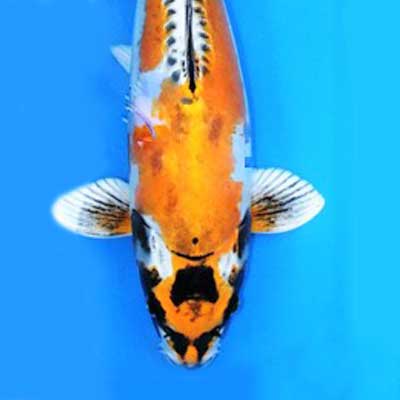
Sitting within the Hikarimojomono group, and developed from the Kumonryu, Kikokuryu are the product of a breeding programme which goes back many years. scaleless (doitsu) koi with a white base combined with areas of black inside the single row of scales, along the back outside of the row, and on on the head around the eyes and nose.
Kikokuryu are commonly considered to be metallic versions of Kumonryu.
Bloodlines include: Aoki, Igarashi, Jamajo Koi Farm.
Variations of Kikokuryu include: Beni- Kikoryu (Red and black) Ki-Kikukoryu (yellow), Kin -Kikukoryu (greyish metallic).
Kin Kikokuryu

Yamatonishiki
Yamatonishiki are Sanke with a platinum background.
The black and red pattern is muted by the white metallic background, and so they do not display the same level of colour contrast as the Sanke, though they can appear very harmonious and pleasing to the eye.
Large Yamatonishiki are very impressive, but good examples are rare. These koi tend to lose their intense colouration as they grow.
Bloodline: Was first developed by Seikichii Hoshino in the early 1960’s.

Goshiki
Goshiki translates as “five colors”, and their lineage goes back to just after WW1.
Goshiki are koi with a solid white base with black and blue edging, and red and black patterns overlaying the white, black and blue colours of the base.
Only very rarely are all five colours able to be detected easily in current strains, and there are many different colour variations. Some bear a resemblance to Showa, though they are not closely related. Others bear a resemblance to Asagi from which Goshiki were developed.
The bright red pattern can vary widely, some Goshiki being almost neon-red in colour, as can the grey base-colour which can range from light grey to almost black. Some Goshiki will have a white belly, and some black-edged spots on a light grey background.
When it come to Goshiki you might say “anything goes” as far as pattern and pattern distribution are concerned. Over the years successive pairing of Goshiki has stabilised the variety.
Variations of Goshiki include: Gin Rin Goshiki and Doitsu Goshiki. Vary rare pairings of Goshiki with either Sanke or Showa produce some unique, unusual and interesting Koi.
Online Shop
Discover our stunning selection of koi! We’re constantly updating our online shop with new arrivals. Browse our extensive collection and find your perfect pond centerpiece.
Some of the best fully quarantined Japanese Koi available in the UK
Our koi go through a four-week CEFAS approved quarantine programme and PCR testing on arrival in the UK
We personally select all our Koi
There are many breeders to choose from. We have dedicated a page to highlight some of the ones that our Koi come from.

Contact us and arrange a visit
We are based in Sawbridgeworth, CM21
Please call us on:
Geff: 07940 456004
Jan: 07702 266712
or email us at koiman.enterprises@gmail.com
to arrange a visit