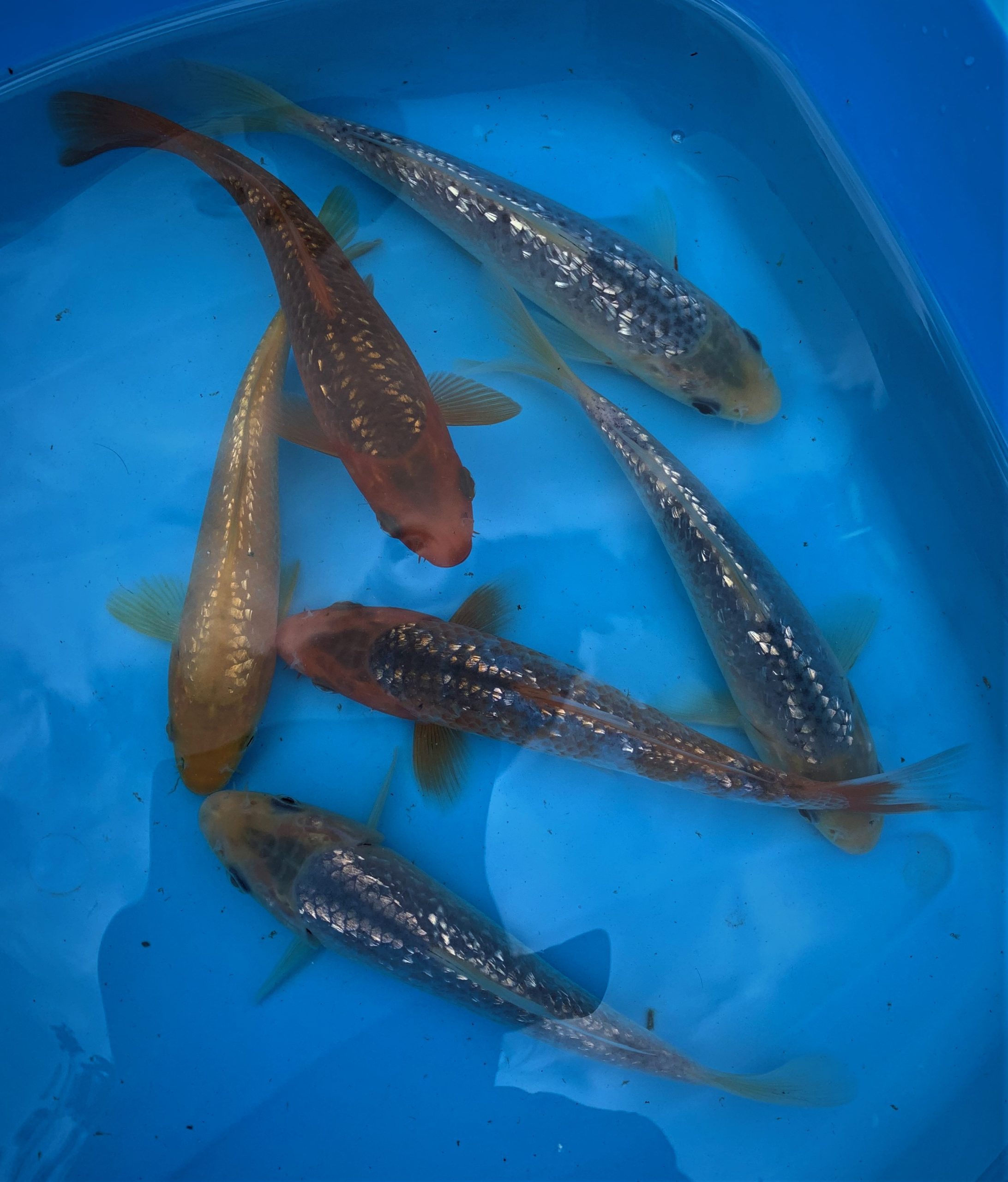
As the name suggests, this recent addition to the wide range of Koi varieties, the Golden Corn koi bear a striking resemblance to a corn on the cob! But how did it come about?
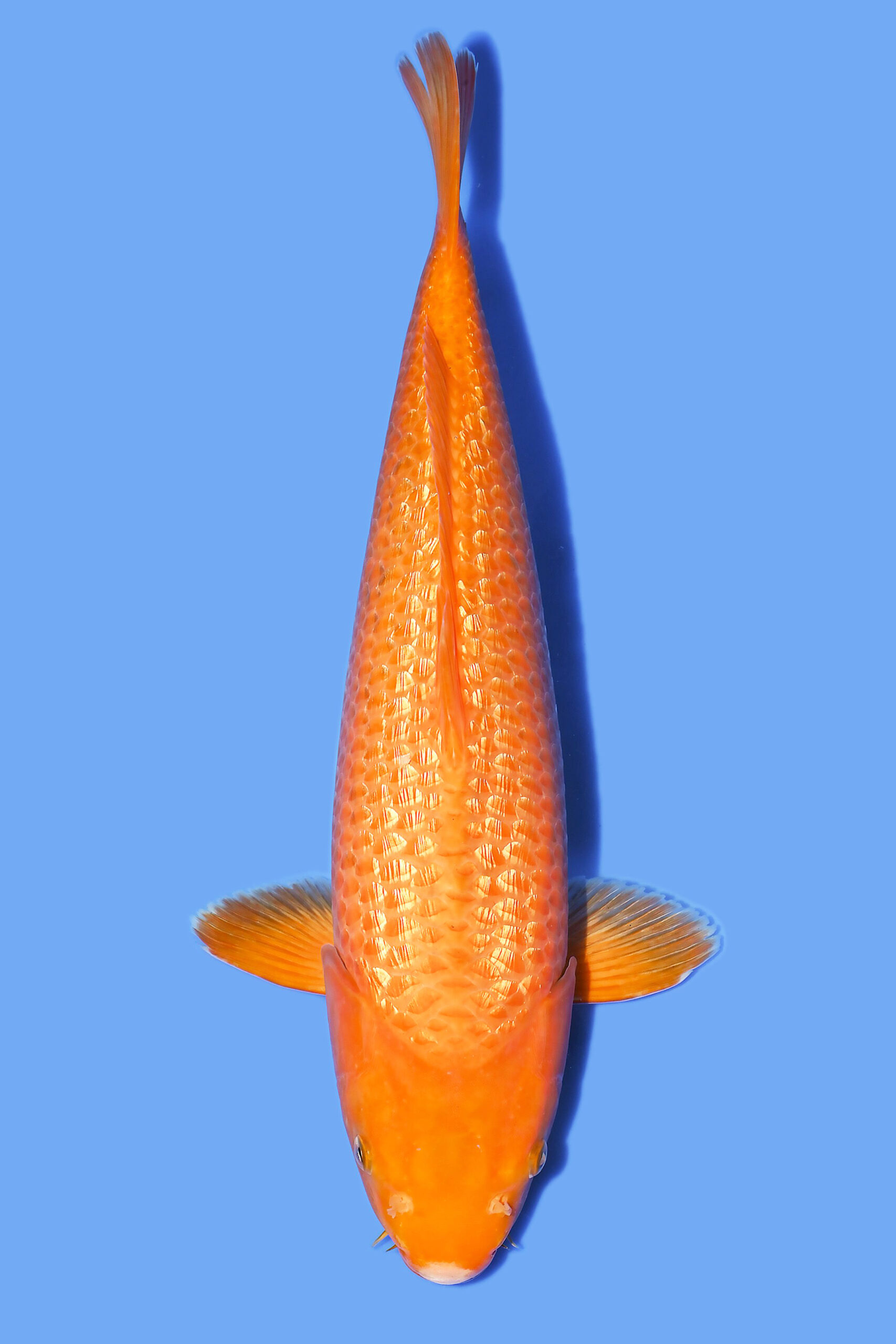
There are a few different versions of the Golden Corn but the most well-known version has a bright yellow base colour with red reticulation on the scales as well as a Gin Rin sparkle across the whole body. The best Golden Corn also have a red speckled pattern, called kanoko (KAN-oh-KOH), which adds emphasis to the red-coloured reticulation.
The other two variations both have a grey-white base colour. – one has a bright red-orange kanoko and reticulation patterns like the first variation and the other has the same pattern but with a yellow colouration to the kanoko and reticulation.

Bred by Mr. Youichi Taniguchi at the Taniguchi Koi Farm, Golden Corn koi were first introduced to the general koi world at the 2020 All Japan Koi Show. A very large and impressive Golden Corn was displayed, and won, the Kawarimono category (the competition group for non-metallic koi that do not fit into any other category). Over the course of the weekend, many koi breeders and show goers were able to see this exciting new koi and it became an instant hit.
Because they have the blood of Chagoi and Karashi (see below), Golden Corn koi have the DNA to grow big. You can feed them as much as you want and enjoy the jumbo growth.
Because they have the blood of Chagoi and Karashi, Golden Corn koi have the DNA to grow big. You can feed them as much as you want and enjoy the jumbo growth.
Drastic change of pattern is also a feature of the Golden Corn. As they mature their.Kanoko patterns emerge Some koi may not even be recognizable from how they looked when they were babies. So even if they look boring or you think they have no future, you should hold on to them. “You will be surprised,” Taniguchi insists

How did they come into being?
In order to produce a recognised, stable new variety of koi of good quality, a breeder will need to work through a number of generations, and the priority is to develop a koi that will have a great shape and grow quickly to show quality in as little time as possible, until the variety is good enough for koi shows.
Mr Taniguchi has worked on the Golden Corn variety since 2005, and he stabilized it in 2017. He started with one of his most prized koi, a very large Chagoi female measuring over 1m in length, and which was a parent to many Chagoi, Ochiba, Karashigoi and other Chagoi cross varieties. Her fantastic size meant that all her offspring were considered Jumbo koi and grew to breeding age very quickly.
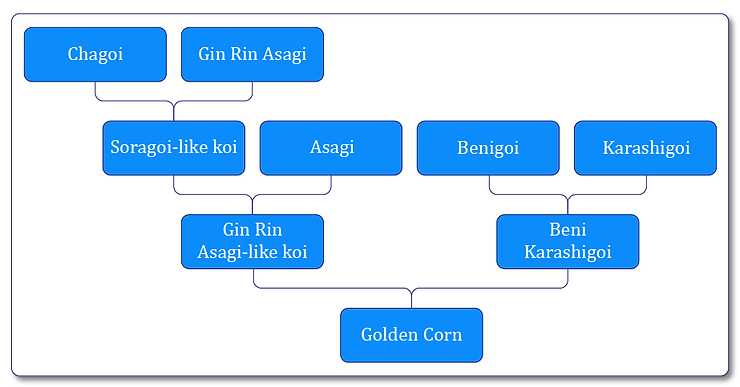
The heritage of the first Golden Corn Koi
He then had to selected a male to pair with her – a Gin Rin Asagi, chosen as this would introduce the Hi colouration, the Gin Rin sparkle, and the fukurin reticulation pattern, that he was looking for – all characteristics he was looking for in a Golden Corn.
This pairing produced.a Gin Rin Sorogoi-like female koi – she looked like a Soragoi but had a small amount of hi-coloured kanoko pattern. This was what made it different to any existing koi variety and was a great starting point on the journey to the Golden Corn.
This female was bred to another Asagi male, but this time without any Gin Rin pattern – the intention being to enhance and increase the hi kanoko pattern of this generation without losing the base colouration or the fukurin reticulation.
This pairing produced a female offspring that Mr Taniguchi got very excited about. He described this particular koi as a Gin Rin Asagi-like koi because, while the colouration of the koi was very similar to that of an Asagi, the hi colouration that you would typically only see on the belly and sides had spread around the body and was now also beginning to appear on the top of the body in a kanoko pattern.
Mr Taniguchi was already a very experienced breeder of both the Benigoi (single-coloured red koi) and the Karashigoi (cross between a Kigoi, a single-coloured yellow koi and a Chagoi) varieties. He knew from experience, that a cross between these two varieties would likely produce a light-yellow fish with red spots. So, he bred his female Gin Rin Asagi-like koi to one of his male Benigoi-Karashigoi crosses – hoping to maintain the hi kanoko pattern while achieving the light-yellow body colour of the Karashigoi. (rather than the the grey-blue of the Asagi)
It took 3 generations for Mr Taniguchi to achieve what he had been aiming for – the light-yellow body colour and the strong hi kanoko pattern. Now, having created the variety, all he had to do was continue developing the various aspects of the pattern and grow them large enough to become show-worthy.!

We will never know whether today’s Golden Corn are what Mr Taniguchi expected when he started his breeding journey nearly 20 years ago. but he certainly created an amazing new and somewhat unpredictable Koi variety. Their mixed heritage of chagoi, asagi etc, means they need time to develop to their full potential. Depending how old they are Golden Corn koi may even look ugly when you receive them, but as you can see above, you should do not give up. Take care of them for at least three years in your pond. Good luck!