
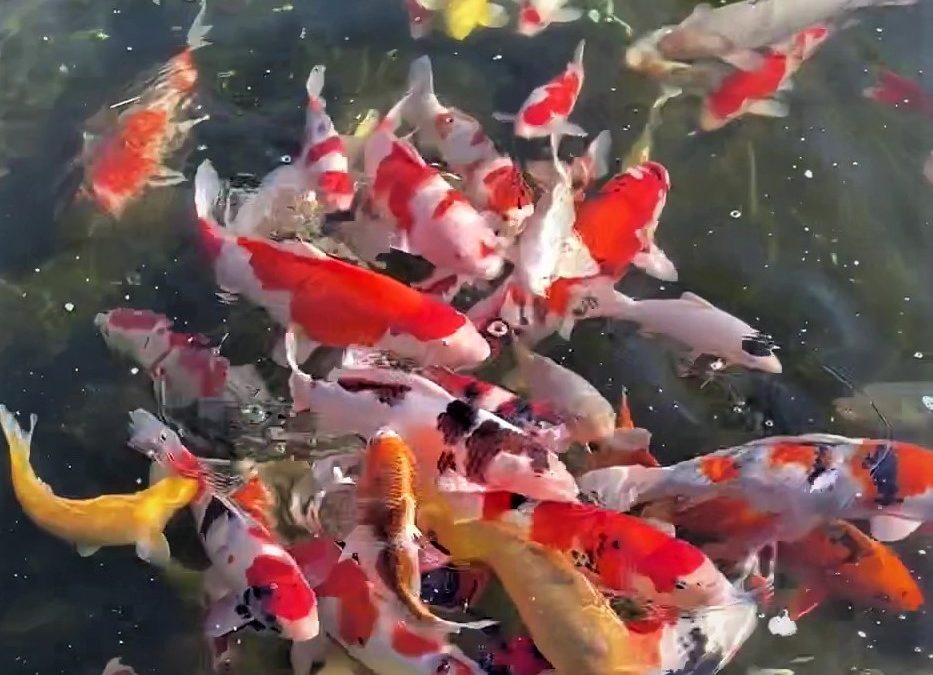
A brief introduction to our thinking around the importance of being aware of what chlorine in your pond can do – and how to avoid any problems.
FACT – Concentrated levels of chlorine kill fish and other aquatic life-forms
Water treatment facilities (domestic water suppliers) use chlorine to treat drinking water – to reduce bacteria and viruses. It can combine with certain organic compounds (that might be present in your water) forming trihalomethanes, a family of compounds which can be carcinogenic.
Consequently, many water companies have switched from using chlorine to using chloramine – a compound containing both chlorine and ammonia. It is much more stable than chlorine, but it still poses a significant headache for pond owners.
More detailed information about Chloramines is available – eg https://en.wikipedia.org/wiki/Monochloramine
For a long time, water providers and pond owners have argued about the need to watch the level of chlorine in artificial ponds and whether or not those chlorine levels are harmful to the aquatic life.
Even when koi and other pond fish show no apparent ill effects from untreated water, it doesn’t mean the chlorine isn’t stressing or harming them.
The amount of harmful damage depends on many factors including:
- Chlorine is an oxidizer, which removes the necessary slime (mucus) coat from the skin of koi and other pond fish, allowing bacteria a route of access as well as causing stress and stress-related illnesses.
- Chlorine damages the gill structure in koi and other pond fish, causing serious long-term issues and making it difficult for the fish to breath.
- As the pond’s pH levels go down, chlorine becomes more toxic.
- The presence of phenols, a toxic organic chemical found in some types of organic wastes, can combine with chlorine to make further compounds which are even more toxic.( this waste can be uneaten food, excreta from your fish, rotting vegetation from plants and leaves, other pond life such as fly lavae etc. – basically anything that falls in , sinks to the bottom and stays there)
What effects do chlorine levels have on to pond life?
- 0.006 mg/L will kill fish fry in about two days.
- 0.003 mg/L will kill insect larvae, such as dragonflies.
- 0.002 mg/L will fatally damage the sensitive skin on tadpoles, frogs, newts, and other amphibians.
- 0.01 mg/L is the maximum level that experts say adult fish can tolerate without significant damage.
- 25 mg/L is the level at which only the hardiest koi or other pond fish can survive.
- 37 mg/L is the level at which all pond fish will die.
.
When exposed to high levels of chlorine, Koi and other pond fish show signs of irritation, such as swimming erratically or jumping and attempting to leave the water
At lower levels, chlorine is not necessarily life-threatening to koi and other pond fish, but it can still cause harm to them.
Affected fish might exhibit fast gill beats and gasp at the water surface to get enough oxygen into their tissues.
These symptoms can be easily mistaken for low-oxygen problems, gill parasites or another gill disease, when in fact the use of “raw” tap water might be to blame.
If you suspect your fish are suffering chlorine damage, increase aeration in the pond for a few days. This can improve their chances of recovery.
So – how can we reduce the chances of the chlorine and/or chloramine getting into the pond and causing damage?
There are a number of ways to reduce, or better still prevent, the chlorine/chloramine levels building up in a pond:
- Some people recommend performing partial water changes without treating the tap water to remove chlorine. This is an error and should be avoided as it could create untold devastating issues.
- Chlorine is relatively unstable in water, escaping to the atmosphere on its own. Water left standing in a container, with enhanced aeration, will generally be chlorine-free 24 hours or less.
- Whenever you use tap water to fill, or change water in, a pond, you must dechlorinate it.
Chlorine is a gas which is added to tap water to kill bacteria, viruses and protozoans, so if untreated tap water containing chlorine/chloramine is added to a pond it will kill good bacteria (such as your filter bacteria), as well as bad.
“Gassing off” You may be advised simply to allow the water to “Gas off” – ie to let the water stand for 24 hours before it comes into contact with fish or your precious filter bacteria,
BUT you won’t know if it’s gassed off properly without using a Chlorine test kit, and if you’re going to use a chlorine test kit, you may as well just use a dechlorinator (see below) AND don’t assume that “gassing off” will remove everything that you need it to – if its chloramine, not chlorine in the water, it won’t gas off.
You may choose to use a water treatment chemical such as Sodium Thiosulfate which easily neutralizes chlorine. They typically cost pennies per use and safely remove chlorine. Make sure to read the label to ensure you purchase and use the right product for your needs.
NB. Chlorine-neutralizing chemicals, such as sodium thiosulfate, only neutralize the chlorine portion of the chloramine, neglecting an even bigger problem – the deadly ammonia remains in the pond, adding to the ammonia load on the filtration system.
The consequences of ammonia poisoning can be devastating to koi and other pond fish. The pond’s biological filter will eventually convert this additional ammonia to nitrite/nitrate, but the time it takes might be longer than the fish can tolerate. AND, the initial presence of the chlorine may have already caused irreparably damaged to the biological filter, rendering it useless – often termed a “crash”.
Rainwater – Rainwater is normally chlorine-free, but – not always as pure as you may think – if it hasn’t rained for a while, or if you live in a city or close to any factory chimneys and/or industry it can be contaminated with all manner of things. To be on the safe side, filter any rainwater through activated carbon, but if you’re going to do that you may as well use either of the methods listed below as it’s just as easy, or even easier.
Better still – use an in-line de-chlorinator.
If you use large amounts of tap-water for your pond, have a pond with an automated top up, or you just want chlorine-free water for other applications you may want to consider one of these. They come in two main types –
A large pressure vessel that is filled with ACTIVATED CARBON GRANULES, which are available in a range of sized depending on your needs. However, the activated carbon will not last forever, and will have to be replaced or at least re-charged when the granules become exhausted – either way a messy job.
A multi-pod system which consists of pre-made filters, which take ready-made filter cartridges that are easy to acquire, and most importantly – easy to change.
Multi pods have the advantage that they can take different types of filter cartridges depending on what you most need to remove from your water. They are also available in different sizes depending on your requirements. The most usual arrangement would be, Pod 1 – 5 micron filter, Pod 2 – Activated granular carbon, Pod 3 – Activated carbon block filter.
Some units may provide 100,000 litres or more of de-chlorinated water– enough to fill even the largest ponds. Most will have a maximum flow rate stated, as it’s all about contact time. The slower you push water through the unit, the more time it is in contact with the carbon inside, and the more effective it will be.
BUT don’t forget, whichever type you go for, eventually the media will become ineffective and will need to be re-charged or replaced. Not all de-chlorinators available can be re-filled.
NB Activated carbon does not adsorb chloramines but rather removes them through its ability to act as a catalyst for the chemical breakdown of chloramines to innocuous chlorides in water. The finer the carbon granules or mesh size of a carbon filter cartridge. the more effective it will be.
SO – that’s our explanation – what you decide to do in your own pond is your decision